
The truth is, people aren’t consciously running their lives.
In today’s Tools for Change, we’re going to show you a simple framework that can help you to become more aware of your mind and of your emotions and your thoughts, because all awareness is where change begins.
Hi, I’m David, and welcome to Tools for Change, a series where we explore practical psychology, emotional intelligence neuroscience, performance psychology, and strategies that help you to live a better life and also to be able to use in your life immediately.
It’s about really developing and learning how to manage your own mind because here’s the reality.
Your mind is your greatest asset, how much time do we really put into learning about it?
It’s controlling our lives. And if we don’t learn to manage it, it can quickly become our greatest limitation.
Think about the times where you’ve wanted to do better, and you’ve never got those results. So why do people live on autopilot, or what does it even mean? In some ways, you could call it trance.
So let me ask you a question.
Have you ever driven somewhere, arrived without really remembering the journey, or walked into a room, for example, and you’ve forgotten why you’re even there?
Here’s what’s interesting, much of our life works exactly the same way.
It runs on patterns and programs. Researchers estimate that a huge part of our life, daily thoughts, our behaviors, decisions, emotions are running automatically.
In fact, over 90% of what we do daily in those thoughts, emotions, etc, are being driven by our patterns, beliefs, emotional patterns, thought patterns, and experience that we’ve accumulated over the years.
It feels like we’re running on repeat. Have you ever wondered sometimes why you’re repeating the same things?
Think about in the morning when you consciously decide to brush your teeth.
Did you consciously think about making a coffee or which shoe you were going to put on first when you were getting ready for work?
You just did it, and these are programs. Your brain’s constantly looking for efficiency, and it creates automatic patterns all the time.
And this is so we don’t have to think about everything. Think about driving, as an example.
The issue here is it doesn’t only automate useful habits, it also automates negative thinking, worry, self-doubt, emotional reactions, stress, avoidance, procrastination.
We are aware of those things and I’m sure we’ve all come across them at some stage in our lives.
If we’re not aware of these patterns, they quietly begin controlling our lives at the unconscious level. And remember, you can’t change a pattern until you become aware of it, and that’s why we say awareness is king because when we become aware of something, it’s the first stage for us to making change. To have any understanding of this, we first need to have an understanding of the mind.
I have deeper videos on this topic – check out our You Tube channel for more… www.youtube.com/@heartmindacademy
The conscious mind, this is the part you’re thinking with right now It’s responsible for making decisions, solving problems, setting goals, planning, focus, those sorts of things, where it places your attention at any one time. It’s logical and it’s analytical, but it’s actually a relatively small part of your overall mental processing.
Whereas the subconscious mind or the unconscious mind, this is where our habits lie, our emotional patterns, our memories, our beliefs, and automatic behaviors. These are all stored at the subconscious level. Think of it like an operating system that’s running quietly in the background, like your computer.
It remembers past experiences and can easily be triggered by certain things, which sets off those behaviors, beliefs, etc, which can lead to emotional reactions.
It creates emotional associations. It runs previously learned behaviors automatically. For example, if someone ever criticized you repeatedly when you were young, as you were growing up, there’s a good chance your unconscious mind may have developed a belief like, “I’m not good enough, I’m not worthy,” those sorts of thoughts.
Years later, these beliefs, which were stored at the time, still influence our confidence. And even if you consciously know it’s not true, it doesn’t really matter because when it’s unconscious, will always override your conscious mind because it’s thousands of times more powerful.
Real change happens when you become aware, when you become aware of your unconscious patterns driving those behaviors. And here’s a simple model, that I teach regularly. It’s very simple. You can learn it in just a few moments because everything begins with a thought.
So let’s say you think, “I’m going to fail.” How do you think that thought’s gonna make you feel? Maybe anxious, nervous, uncertain? These emotions then influence our behavior, how we perform Our outcome, our results. You hesitate, you avoid taking action. Perhaps you procrastinate, and eventually it ends up with a poor result.
So now imagine if we flip the script for a moment, changing the original thought. “I may not have all the answers, but I can learn.” Creating a possibility. It’s a different thought, but it creates a different emotion. More action creates better results, better outcomes.
This doesn’t mean every positive thought magically becomes reality. What it means is that your thinking shapes how you respond, and that response changes your outcomes. So remember, you don’t need to control every thought. It’s impossible. You can’t control your thoughts completely.
This is something I think is incredibly important because many people believe taking control of your mind means never having negative thoughts. That’s impossible. Every human being experiences fear, doubt, frustrations, uncertainties.
The goal isn’t to control every thought. The goal is to control your responses to your thoughts. Think of your thoughts like cars driving past on a road. You don’t have to jump into every single vehicle or clouds floating across a bright blue sky.
Some thoughts deserve your attention, others simply deserve to pass by, just like the cars on the road, the clouds in the sky.
And instead of saying, “Why am I thinking this?” Or, “Why am I thinking this way?” Ask yourself, “Do I need to believe this? Do I need to believe this thought?” That single question creates a psychological distance, kind of like a dissociation, and that distance gives you choice.
And when you have choice, it’s the first step to becoming successful, Cause change is always happening from awareness first. So it’s the awareness that we need to create, and awareness is the foundation of all personal change, changes that are going to help us and lead us to where we need to go.
You cannot change what you do not notice. So once we start paying attention to what triggers our emotions, what stories are we telling ourselves? What things are we saying to ourselves on a regular basis? What assumptions are we making.
How do we typically react under stress?
This is very powerful. It may seem simple at this stage, but you’re now starting to control your emotional awareness.
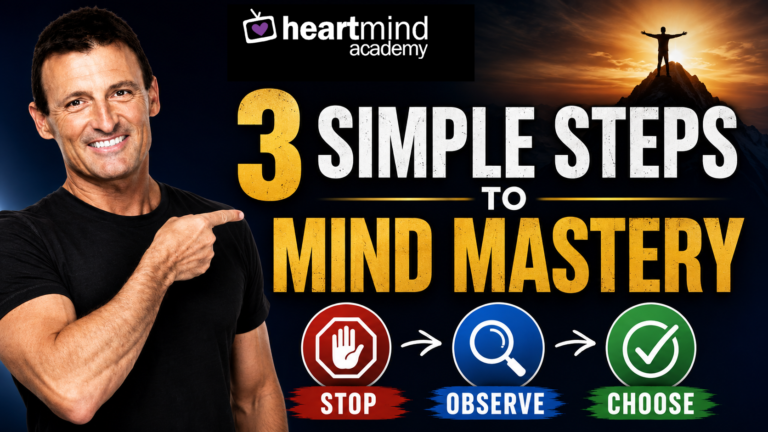
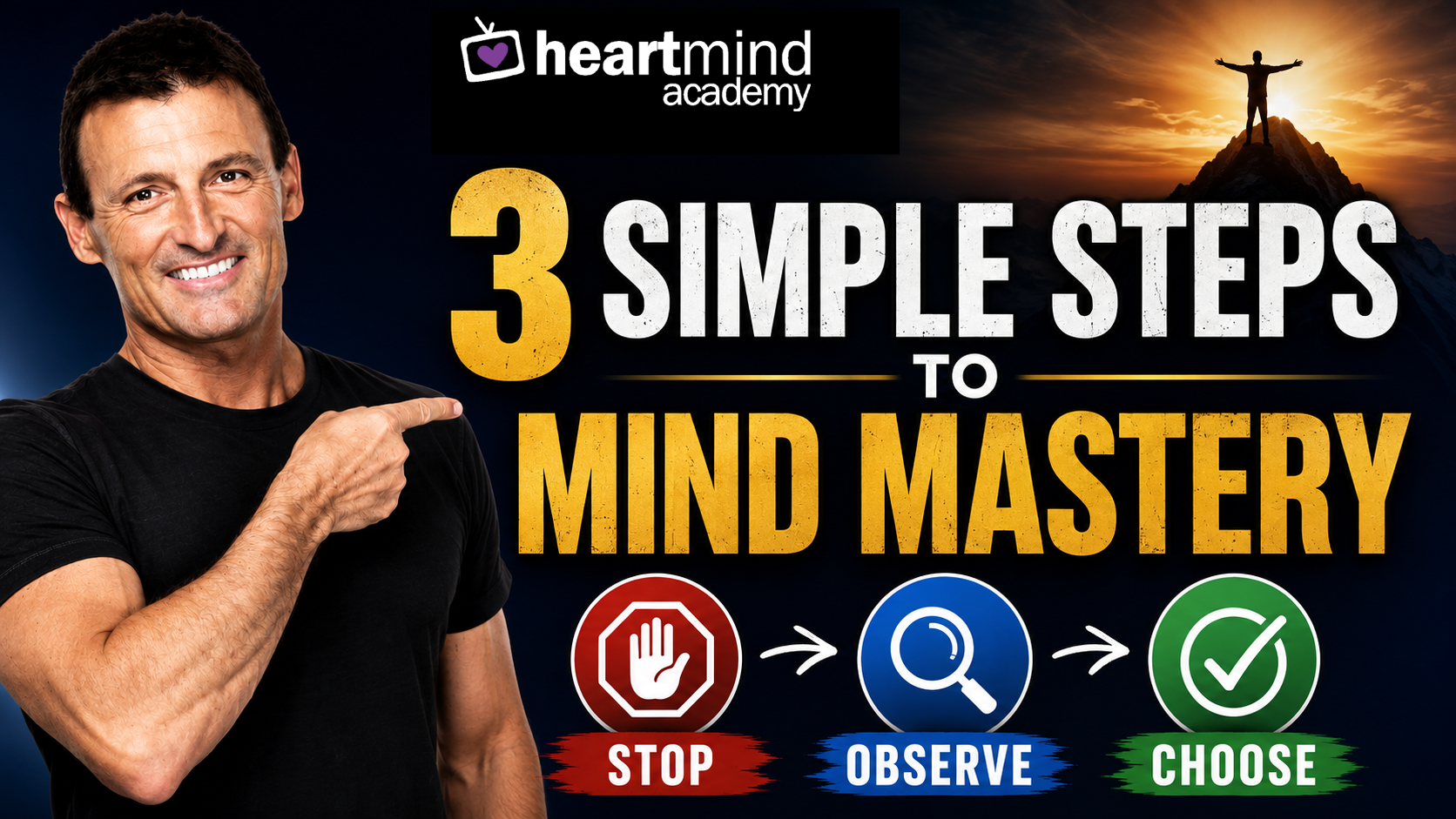
Here’s a simple exercise that you can use every day, and I call it simply a stop, observe, choose.
It’s a smaller version of, a bigger technique that we teach in emotional intelligence.
Take one slow breath, a deep breath, and interrupt the automatic reaction.
Be an observer and ask yourself, “What am I thinking?
What am I feeling? What’s actually happening right now?” Simply notice without judging yourself. Like being neutral, like a tennis umpire at a tennis match, just observing.
And now ask, “What’s the most helpful response that I can choose right now in the moment?” Maybe it’s staying calm. Maybe it’s asking a better question Maybe it’s having a conversation instead of avoiding the obvious. Maybe it’s taking a small action. One small action is all it needs to break that pattern.
It takes less than 30 seconds, used consistently, it can completely change how you respond to stress, conflict, and everyday challenges…
I want you to remember today, your thoughts will always come and go like clouds against a bright blue background. They will come and they will float on by. Your emotions will always fluctuate. Life will always present challenges to us.
That’s the name of the game But your power lies in your ability to become aware.
That’s what responsibility is. Respond with ability.
Take responsibility and you’ll get change because the quality of your life is often determined by the quality of the choices that you make in the moment, and that matters most.
This is the foundation of emotional intelligence.
So just to finish here, if you found this, helpful, subscribe to our You Tube Channel and follow the Tools for Change, the series that we create every week. Check out the channel, and each week I’ll share practical tools from Emotional Intelligence, Neuroscience, NLP, mindset, and Positive and Performance Psychology.
At Heartmind we help you build a stronger mind, a calmer mind, so that you have more control, more understanding of your mind, become more resilient, and to have better choices, better decisions, and you’ll get better results. And better outcomes.
If you prefer to watch videos you can view this in a video by clicking the video below
See you in the next Tools for Change episode…
Receive our FREE Heartmind Academy monthly newsletter with updates on our latest hypnotherapy specials, retreats, and certification trainings.

Heartmind Academy empowers individuals & organisations through transformational training Events – Seminars – Programs & Retreats in Mindset, Emotional Regulation, Performance, Leadership, and subconscious change…

© Copyright 2026 – Heartmind